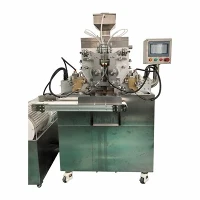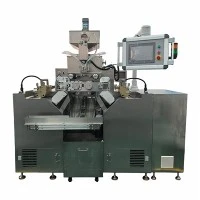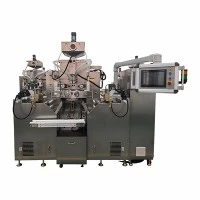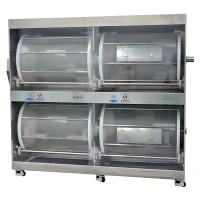

The capsule sorting and separation system is responsible for the orientation and separation of empty capsules from their caps. It includes a capsule hopper, a vibrating conveyor, and a separation mechanism. Some semi-automatic equipment uses a vibrating sorting disc made of plexiglass with funnel-shaped holes, where vibration orients the capsules.
The material filling system is responsible for quantitatively filling the capsules with drug powder or granules. Its core components include a feeding device, a filling mold, and a filling mechanism. Fully automatic equipment often uses a combination of a metering disc and a compaction rod, repeatedly compacting to form a stable drug column before pushing it into the capsule. Semi-automatic equipment typically uses a receiving plate to support the oriented capsules, scraping drug powder from a powder tray for filling.
The capsule closure and detection system is responsible for closing the caps and filling the capsules and performing quality checks on the finished product. It includes a closure mechanism and a detection device. The detection device uses optical sensors or weight sensors to quickly identify and automatically reject unclosed, underfilled, or overweight capsules.
The transmission and control system provides power to all parts of the equipment and enables automated operation. The transmission system consists of a motor, gears, and a conveyor belt. The control system includes an operation panel and a logic control unit. Operators can set operating parameters through the panel, and control is achieved using a PLC. Some newer equipment uses intelligent chip control, featuring functions such as automatic speed regulation and overload alarms.