

Vacuum Homogenizing Mixer
Product Overview
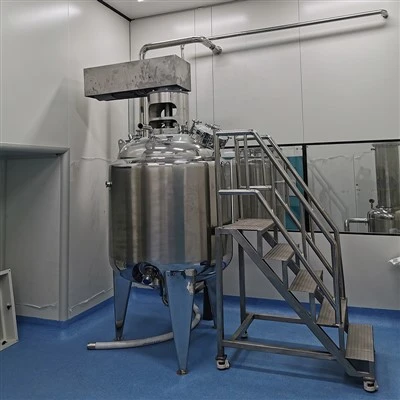
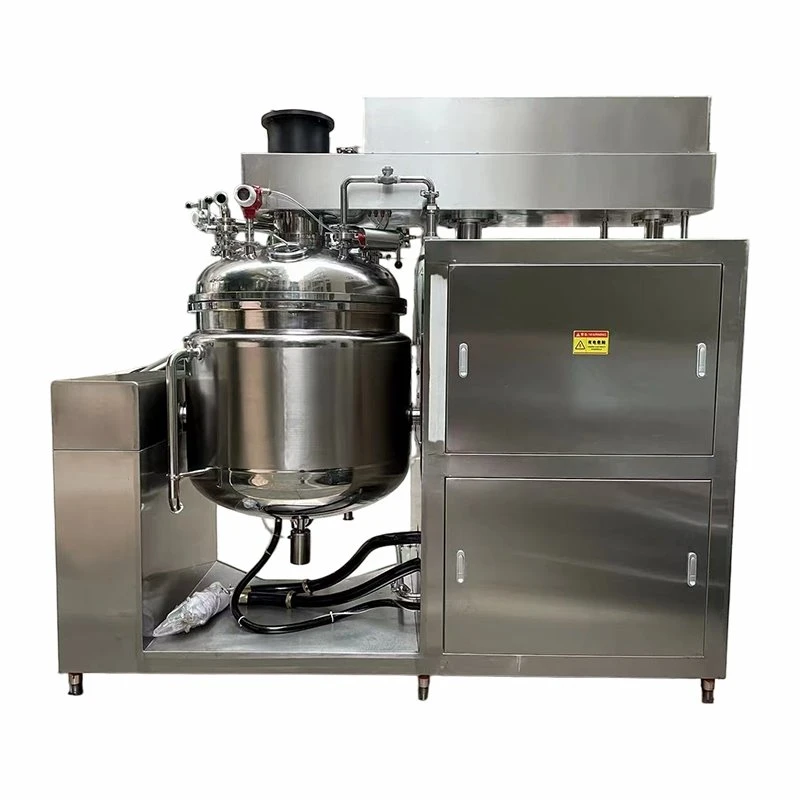
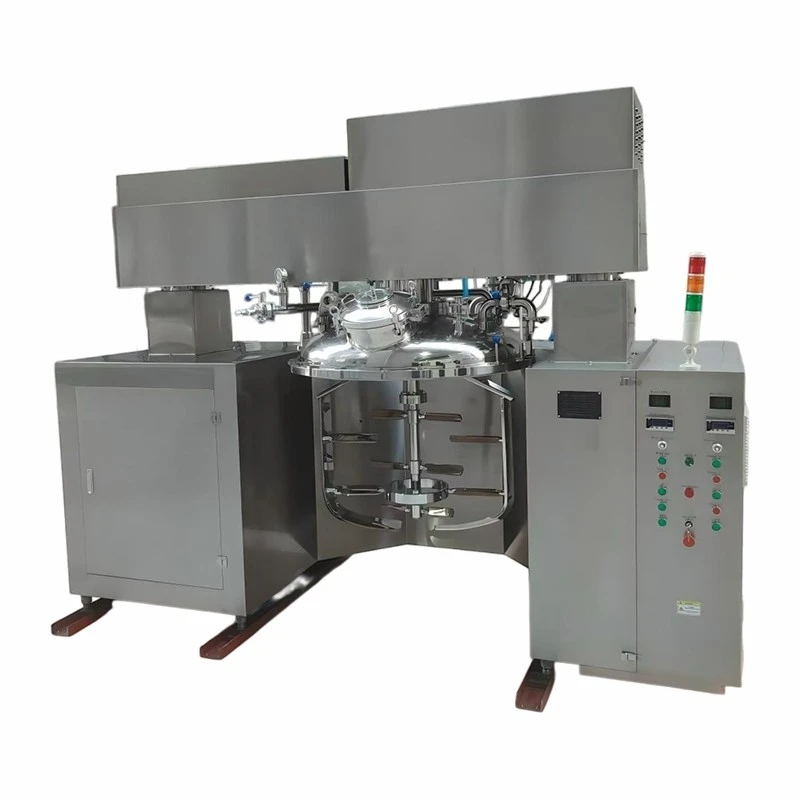
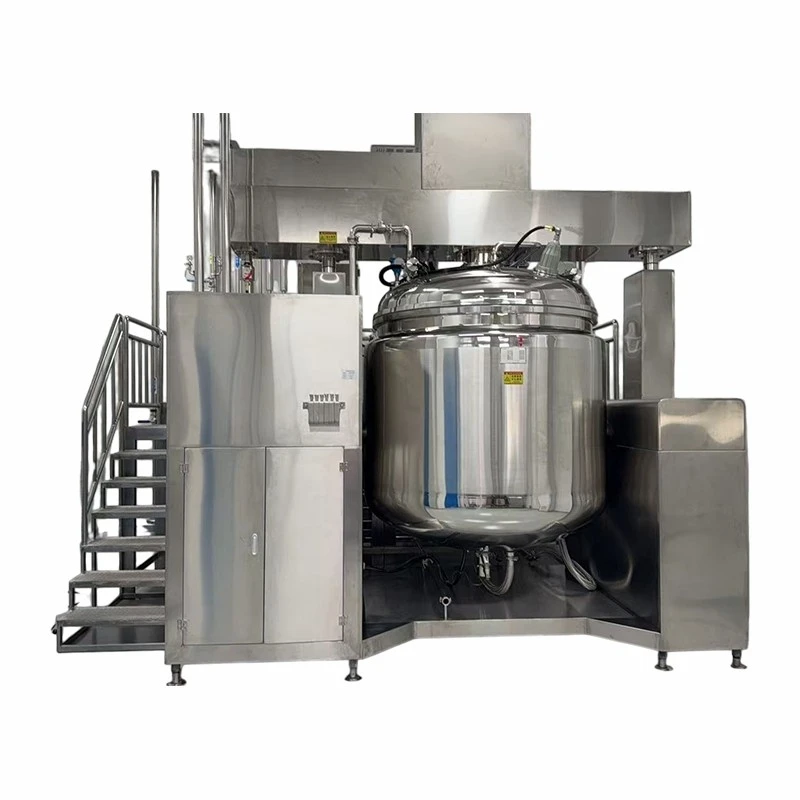
Our Vacuum mixing tank is a multi-functional processing system engineered for the production of high-viscosity emulsions, suspensions, and homogenous blends across pharmaceutical and cosmetic manufacturing. The Vacuum mixing tank combines three core operations - slow-speed wall-scraping agitation, high-shear bottom homogenization, and vacuum deaeration - within a single closed vessel, delivering consistent particle size reduction and bubble-free finished products. The vacuum mixing tank suitable for the pharmaceutical and cosmetic industries for the production of liquid medicines, ointments, toothpaste, cosmetic, etc.
The defining design features - hydraulic lid lifting and tilting vessel discharge - set this system apart from fixed-top emulsifiers. The hydraulic system raises the entire mixing head and lid assembly for full internal access, while the tilting cradle allows the vessel to rotate up to 120° for complete product discharge and thorough manual cleaning. This dual-mechanism design dramatically simplifies changeover, reduces product loss, and supports rigorous cleaning validation protocols required by regulated industries.
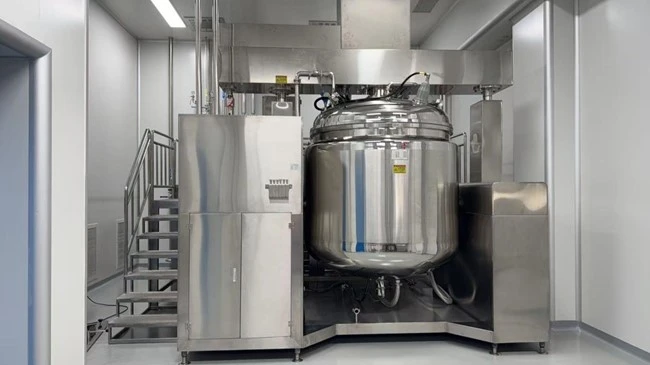
Core Structural Advantages
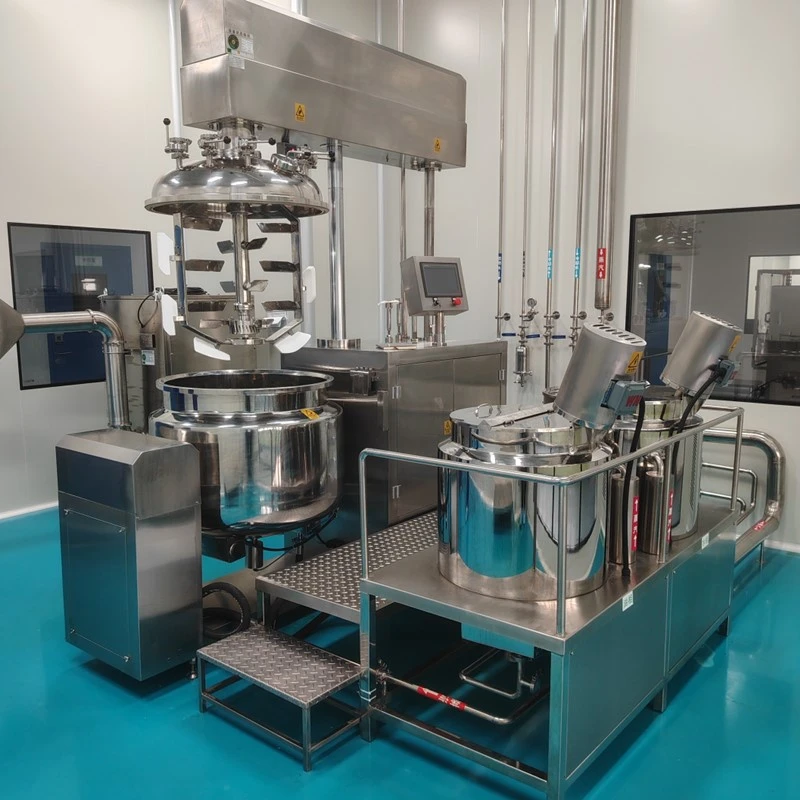
Hydraulic Lid Lifting System
The entire lid assembly - including the central agitator shaft, scraper blades, and all top-mounted instrumentation - elevates vertically via dual hydraulic cylinders, providing unobstructed access to the vessel interior.
• Full Accessibility: Complete exposure of internal surfaces for inspection, manual cleaning, and maintenance of seals and agitator components
• Safe Powder Charging: Open-top loading of raw materials without restrictive manhole openings, reducing dust exposure and improving operator ergonomics
• Quick Seal Replacement: Mechanical seals are fully accessible without vessel disassembly, minimizing downtime during preventive maintenance
• Controlled Descent: Hydraulic speed regulation ensures smooth, safe lowering with automatic safety locks in raised position
Tilting Vessel Discharge Mechanism
The processing vessel is mounted on a heavy-duty cradle frame with hydraulic or manual tilting capability (up to 120°), enabling gravity discharge of finished product.
- Maximize Product Yield: Complete gravity drainage of high-viscosity materials (ointments, creams, toothpaste) that resist bottom-valve discharge - product residual typically < 0.5%
- Cleaning Validation Friendly: Tilted position allows full drainage of cleaning solutions with no pooling zones; all internal surfaces are visible for swab sampling access
- Flexible Discharge Options: Direct discharge into filling machine hoppers, mobile tanks, or intermediate containers without additional transfer pumps
- No Dead-Leg Valves: Eliminates bottom discharge valves as potential contamination points and product build-up areas.
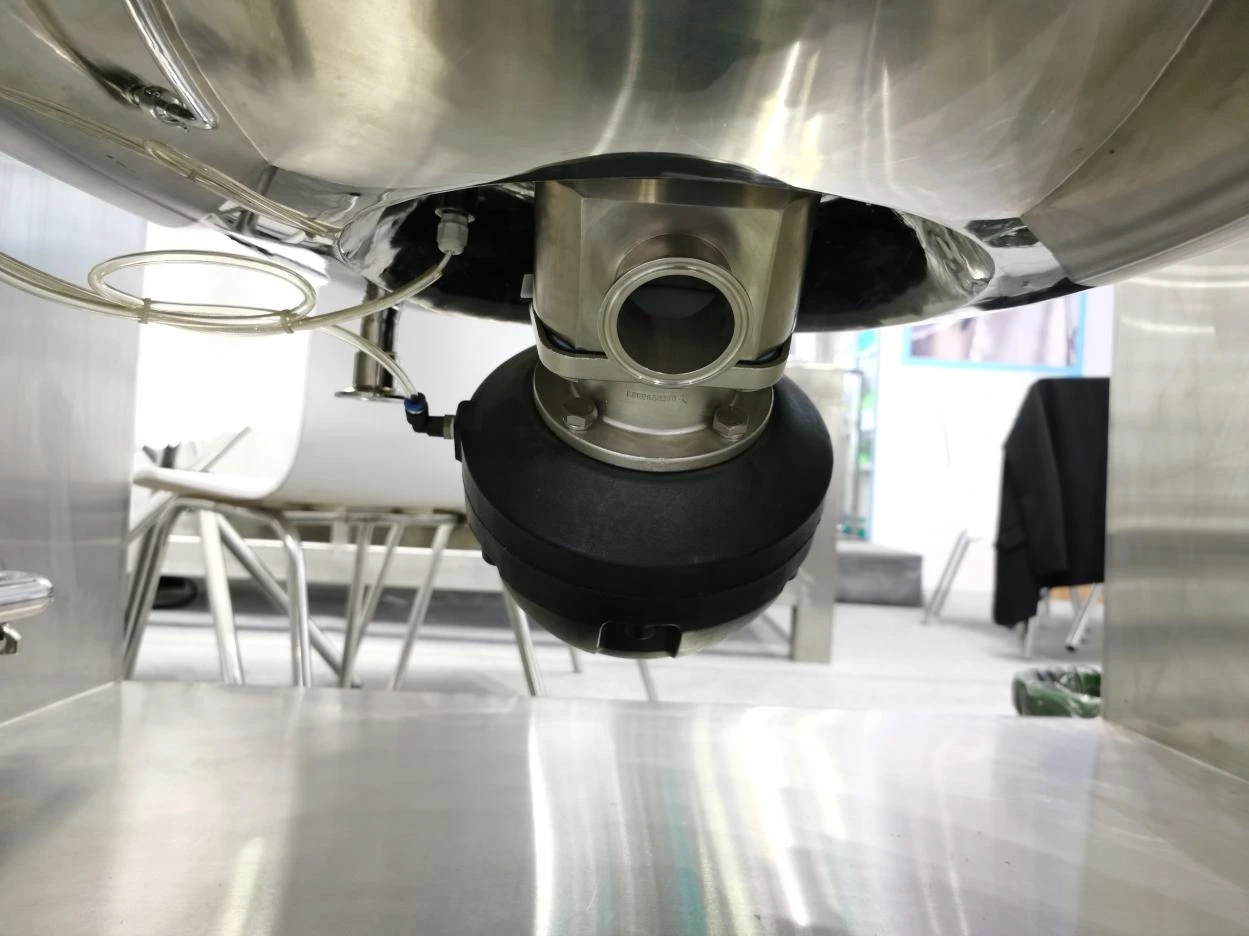
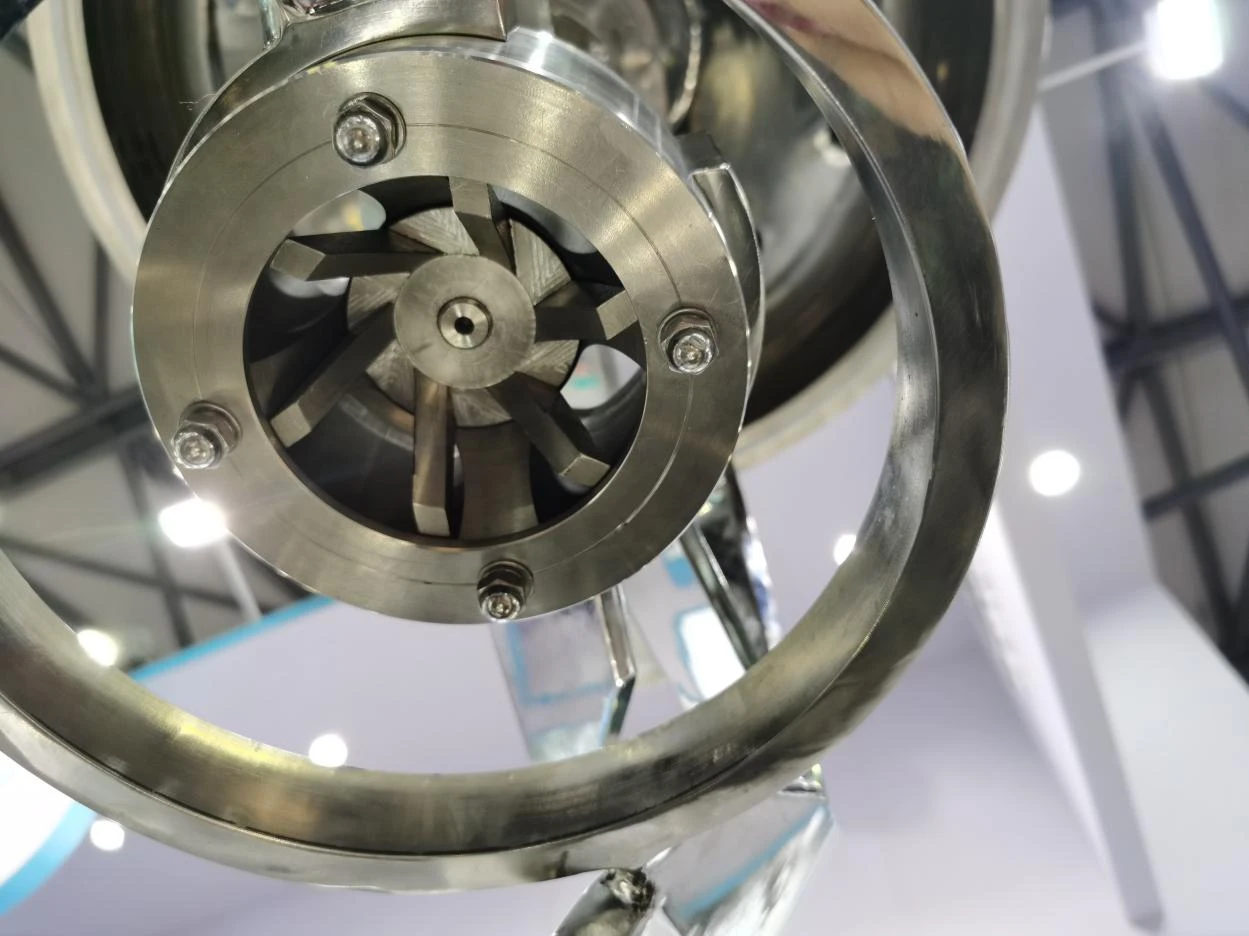
Triple-Action Mixing System
Three independent mixing systems work in synergy to achieve uniform emulsification across a broad viscosity range:
|
Mixing Mechanism |
Function |
Speed Range |
|
Anchor Scraper Agitator |
Slow-speed bulk mixing; PTFE scrapers sweep vessel walls and bottom to prevent burn-on and ensure uniform heat transfer |
10 – 60 RPM (VFD controlled) |
|
High-Shear Homogenizer (Bottom) |
Rotor-stator assembly generates 2800+ RPM shear forces; reduces particle/droplet size to sub-micron range for stable emulsions |
0 – 3500 RPM (VFD controlled) |
|
Central Disperser (Optional) |
Medium-speed turbine for powder wetting and intermediate dispersion between bulk mixing and high-shear homogenization |
0 – 1500 RPM (VFD controlled) |
Dual-Industry Process Adaptability
Pharmaceutical Applications
Engineered to meet the stringent requirements of topical pharmaceutical manufacturing:
• Ointments & Creams: Precise temperature control during emulsification phase; vacuum environment prevents microbial ingress and air entrapment
• Gels & Suspensions: Adjustable shear profiles for sensitive API dispersion without degradation; validated batch records for regulatory submission
• Oral Liquids & Syrups: Gentle mixing modes for low-viscosity solutions; CIP-compatible design for multi-product facilities
• Toothpaste & Dental Products: High-viscosity handling with silica abrasive dispersion; tilting discharge for direct transfer to tube filling lines
Cosmetic & Personal Care Applications
Optimized for premium emulsion quality and aesthetic product characteristics:
• Face Creams & Lotions: Sub-micron droplet size delivers smooth texture and skin feel; vacuum processing ensures crystal-clear appearance for transparent gels
• Shampoos & Conditioners: Controlled surfactant thickening with adjustable shear to avoid viscosity loss
• Serums & Emulsions: Temperature-ramp cooling profiles for stable crystalline structures; post-homogenization maturation cycles
• Toothpaste & Oral Care: High-viscosity mixing with abrasive and humectant incorporation; deaeration for glossy, streak-free paste
Common Production Challenges & Solutions
|
Production Issue |
Root Cause |
Our Engineering Solution |
|
Coarse emulsion / large droplet size causing unstable product, short shelf life |
Insufficient shear energy; poor homogenizer-to-bulk circulation |
Bottom-mounted high-shear rotor-stator (3500 RPM) + anchor scraper continuously feeds fresh material through the homogenizing zone |
|
Air bubbles in finished product causing packaging voids, oxidation, and texture defects |
Air entrainment during high-shear mixing; inadequate deaeration time |
Closed vacuum system (-0.08 to -0.095 MPa) operating throughout mixing cycle; controlled agitation speed to minimize vortex formation |
|
Wall build-up / burnt product at jacket heating surfaces |
Material adhering to vessel walls and overheating |
PTFE scraper blades conforming to vessel geometry; continuously wipes heat transfer surfaces during processing |
|
High product residual after discharge - yield loss and cleaning difficulty |
Bottom valve dead legs; high-viscosity material clinging to walls |
Tilting vessel gravity discharge (120° tilt angle); smooth electropolished internal surfaces (Ra ≤ 0.8μm) |
|
Long changeover times between product batches |
Difficult internal access; complex disassembly for cleaning |
Hydraulic lid lift provides full interior access; tilting vessel drains completely; tool-free seal and scraper removal |
|
Cross-contamination risk in multi-product facilities |
Hidden crevices and hard-to-clean areas |
Sanitary design with no dead legs; drainable in tilted position; CIP spray ball coverage validated; all product-contact surfaces electropolished |
Technical Specifications
Standard Model Range
|
Parameter |
VHM-50 |
VHM-100 |
VHM-200 |
VHM-300 |
VHM-600 |
|
Total Volume (L) |
50 |
100 |
250 |
360 |
600 |
|
Working Volume (L) |
35 |
70 |
200 |
300 |
500 |
|
Anchor Agitator Power (kW) |
0.75 |
1.5 |
2.2 |
3.0 |
4.0 |
|
Homogenizer Power (kW) |
2.2 |
4.0 |
5.5 |
5.5 |
7.5 |
|
Homogenizer Speed (RPM) |
0 – 3500 (VFD adjustable) |
||||
|
Heating Method |
Electric / Steam (jacket water bath) |
||||
|
Temperature Range |
Ambient – 100 °C (±1 °C accuracy) |
||||
|
Vacuum Degree |
-0.08 ~ -0.095 MPa |
||||
|
Lifting Method |
Hydraulic (dual cylinder) |
||||
|
Discharge Method |
Tilting vessel (hydraulic / manual) |
||||
|
Tilt Angle |
Up to 120° |
||||
|
Material (Product Contact) |
SS316L (electropolished Ra ≤ 0.8 μm) |
||||
|
Control System |
Push-button manual / PLC+HMI automatic (optional) |
||||
Standard Configuration
• Main processing vessel: SS316L inner chamber, SS304 jacket, insulation with SS304 outer cladding
• Anchor type agitator with PTFE wall-scraping blades
• Bottom-mounted high-shear rotor-stator homogenizer
• Hydraulic lid lifting system with safety locking device
• Tilting cradle frame with hydraulic or manual tilt mechanism
• Vacuum system with water-ring vacuum pump and condenser
• Jacket heating system (electric or steam)
• Temperature sensor and digital display
• Vacuum gauge and pressure safety valve
• Sight glass with observation light
• Control panel with VFD speed adjustment
Optional Upgrades & Peripheral Equipment
• PLC + 10" HMI touchscreen with recipe management and data logging
• 21 CFR Part 11 compliant electronic batch records
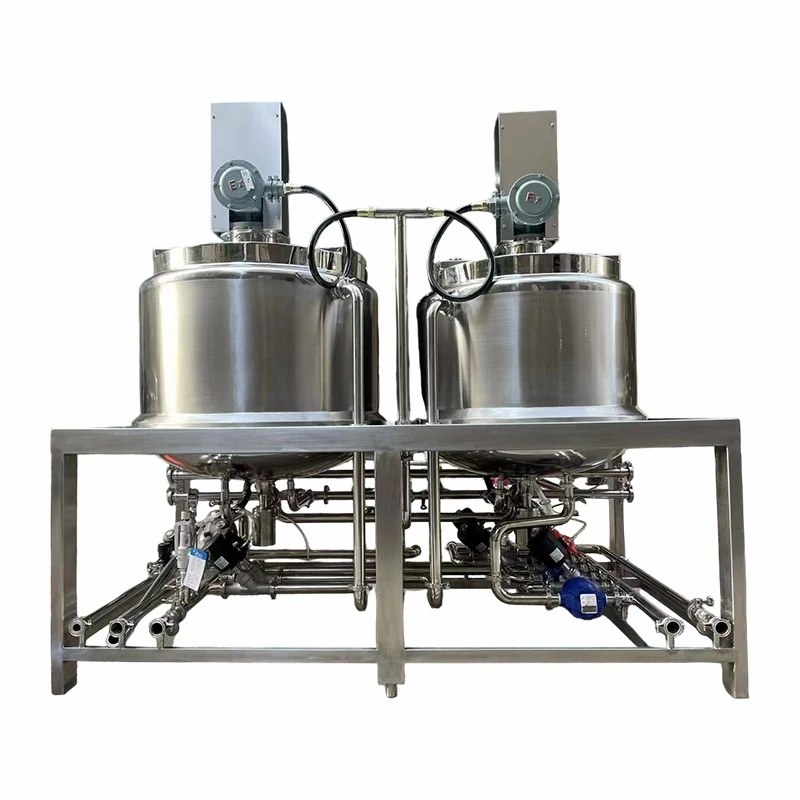
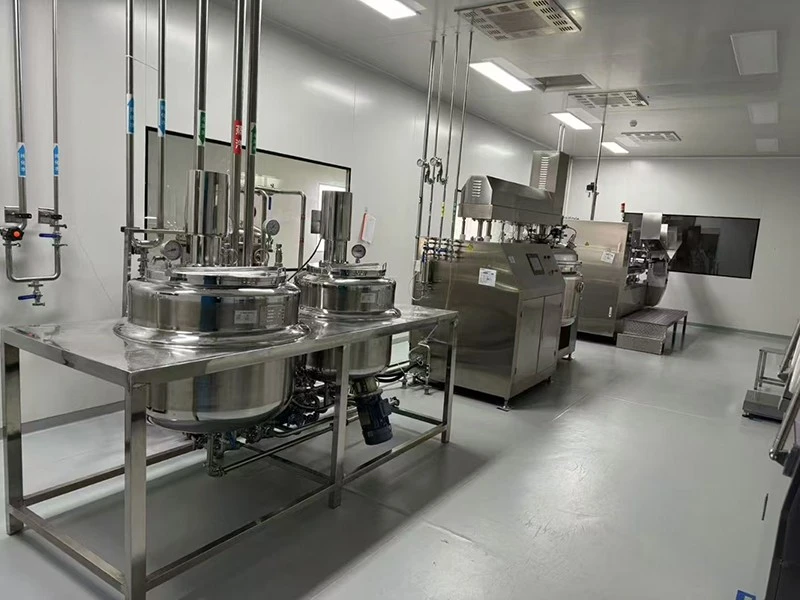
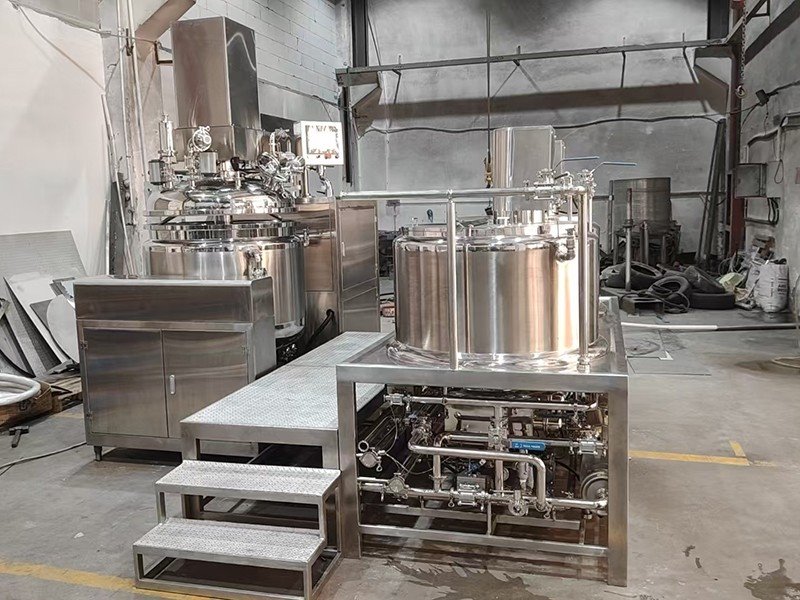
• Water phase pre-mixing tank + Oil phase pre-mixing tank (complete emulsion line)
• Powder induction system (vacuum powder suction)
• CIP spray ball system with rotating cleaning nozzles
• Cooling system (chilled water circulation)
• Jacket cooling for rapid cool-down cycles
• Load cell weighing system (gravimetric batching)
• Inline particle size / viscosity monitoring
• ATEX / explosion-proof configuration for solvent-based formulations
• Pre-mixing tanks (water phase + oil phase) for complete emulsion production line
• Transfer pump with heated piping for viscous product transfer
Cleaning & Sanitation Design
The hydraulic lifting and tilting configuration is inherently superior for cleaning validation - a critical consideration for both pharmaceutical GMP facilities and cosmetic GMP operations:
|
CIP (Clean-in-Place) Capable
|
COP (Clean-out-of-Place) Friendly
|
Regulatory Compliance
FDA 21 CFR Part 211
Equipment design meets cGMP requirements for pharmaceutical manufacturing; non-reactive, non-absorptive, corrosion-resistant surfaces
EU GMP (EudraLex Volume 4)
Cleanable design, drainable construction, no dead legs, and material traceability documentation
ISO 9001
Manufactured under certified quality management system
CE Marking
Available for EU market delivery with full technical documentation file
Material Traceability
SS316L material test reports (MTR 3.1) provided for all product-contact surfaces
Validation Support
IQ/OQ documentation packages available; DQ (Design Qualification) support for regulated pharmaceutical installations
Customization Options
We recognize that every production line has unique footprint and process requirements. Available customizations include:
- Capacity Scaling: From 10L lab/pilot units to 8000L full production systems
- Layout Engineering: Custom discharge height, platform integration, and line layout design to match your existing filling equipment.
- According material and workroom design the best struction machine,like storage moving,double lift system.
- Process Integration: Seamless connection with tube fillers, jar fillers, or intermediate bulk containers
- Complete Production Lines: Turnkey systems including pre-mixing tanks, vacuum transfer, product holding tanks, and control room integration
- Formulation Support: Technical consultation for emulsion formulation optimization and process parameter development.
Our Factory


Hot Tags: vacuum mixing tank, China vacuum mixing tank manufacturers, suppliers